Why does it matter if dogs aren’t really wolves in doggie clothing?
There was a subtle shift in my mind set when I began to take this on board a couple of years ago. What we think tends to inform our actions. So if I think my dog is really wolf, and wolves have such a bad rep, then I need to be on top of keeping my ‘wolf’ in check. So even though I love my dogs, I have to be a disciplinarian and strong authority figure. I cannot let my guard slip (especially with large German Shepherds who are way too smart!) and need to sit on any ‘signs’ of rebellion.
But once I understood that the information is flawed (see previous blog “Wolf?”), I did quite a bit of thinking over time about how that would change my relationship with my own dogs and how I would advise owners of the cute little pups who come to Rose’s Puppy School. It was important that my thinking led to responsible advice handed out to trusting humans. The wrong advice could lead to injury and heartbreak further down the line.
So yes, dogs need guidance and leadership from their humans, but they don’t need punishment. Behaviours we find unacceptable can be interrupted and made unsuccessful consistently for a puppy so that that behaviour falls off the possible options the dogs has to pick from in a given situation. Instead we can substitute behaviours that are more acceptable that we reinforce over and over until that option is the dog’s first choice.
I love hearing from owners about how the puppy is learning not to jump because they have made jumping boring by ignoring the bouncing baby and teaching them to sit and greet a hand instead.
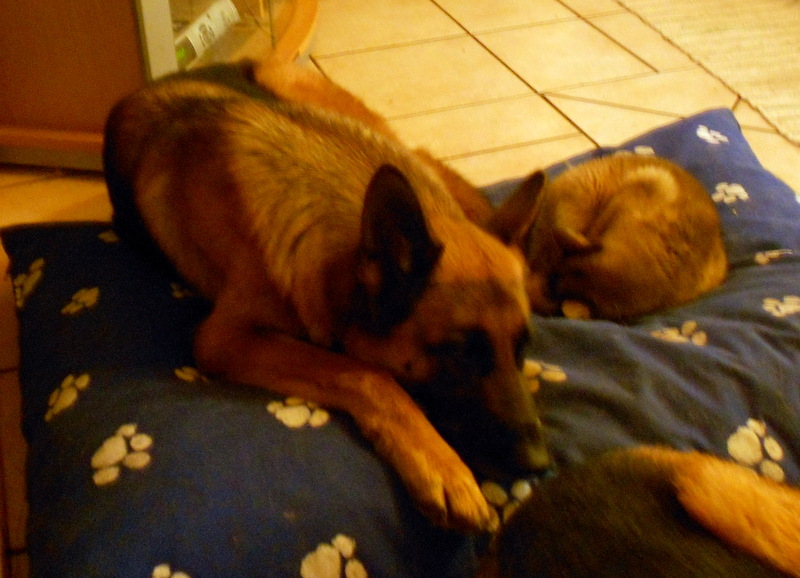
A problem owners often come up against is when their otherwise loving pet decides that couches are made for him, and growls because they try and turf him off. He’s not actually telling them that he’s the boss and a higher ranking animal. He’s just saying he likes that spot and isn’t willing to share or move. You’ll need to entice him off the couch and onto his own bed (lots of yummy treats or a delicious stuffed hoof will make that change a much better option) – do NOT punish him for being on the couch or growling – that could rouse his resource guarding instinct and lead to an argument you may not win. For a while restrict access to the couch when you are not there to remind him he has his own bed. Keep reinforcing the correct sleeping spot and cue ‘on your bed’, ‘go settle’.
Jumping and sleeping quarters are just 2 of many areas of possible confusion when bringing up this different species. The more you read and listen and work with your dog, the more you’ll understand and learn about how to adapt her canine instincts to your human expectations.
So what’s the story with dogs and wolves? We hear here there and everywhere that wolves live in a hierarchical society using strength and aggression to secure a higher place in the pack; that they are led by an alpha male and female that exert their authority by means of dominant displays. We have also been told that dogs are closely related to wolves and therefore use the same social structure and that if we want to live with a dog we need to understand how to be the alpha somebody or other.
This is the theory that I’ve ‘grown up’ in the dog world hearing and to be honest using, without questioning it. But one aspect that has always disturbed me with this model is that talking ‘dominance’ gives some humans the idea that they can use physical force to get their dogs to listen, often going too far in their anger with a ‘disobedient’ animal. Once I learned about positive reinforcement and clicker training I was thrilled to have tools to work with my beloved GSDs without force, and from then on I did all I could to spread the word. Ever since I started Rose’s Puppy School in 1998 I’ve preached PR as the way to go.
The next ‘aha’ understanding came when I read ‘Dogs’ by Ray Coppinger and attended a seminar he gave in Cape Town. Here we learned about the differences between dogs and wolves and that the pack theory had been shown to be incorrect in the light of more recent research. Yeah for DNA!
So point no 1 is that wolves are dogs closest living relatives. However, point 2, dogs are not descended from wolves – rather modern wolves and dogs share a common ancestry that diverged 10 000+ years ago into 2 separate species.
Point 3: The wolves that were studied in the past were North American Timber wolves (less closely related to dogs than European wolves) in captivity. Unrelated, in confined spaces, leaderless, competing for food, space, and mating privileges. This is very different to the wolf in its natural habitat, now shown to live in family groups, usually mom, dad and the kids. In other words, a family. Successful families live co-operatively, with parents as leaders but the kids have roles to play too, especially the teenagers who help with the younger cubs. Observers say that there is little overt aggression in the wolf family groups, that is reserved for intruders. Not pussy cats no, but also not the dominance driven animal usually portrayed.
So wrong assumptions, wrong wolves, wrong situations have led us up the garden path and only in the last 10 years or so have biologists and scientists come to a better understanding through observation of wild wolves and DNA research. This is a very simplified version but if you’re interested, check out John Bradshaw’s’ In Defence of Dogs’ and Coppinger’s ‘Dogs’. I’m sure we’ll learn more in the years to come.
I haven’t even begun on the differences between dogs and wolves, but for now, using the wolf as a possible model: your dog needs you to be his ‘leader’ but not his boss, he needs your authority wielded with love, not aggression or dominance. You’re not the alpha, you’re the parent (if I can use that word without being accused of anthropomorphism). Science has shown that dogs are not trying to take over your world, they just keep doing what works for them and it’s up to us to mold their behaviour to fit into our world successfully.

 rosespuppyschool